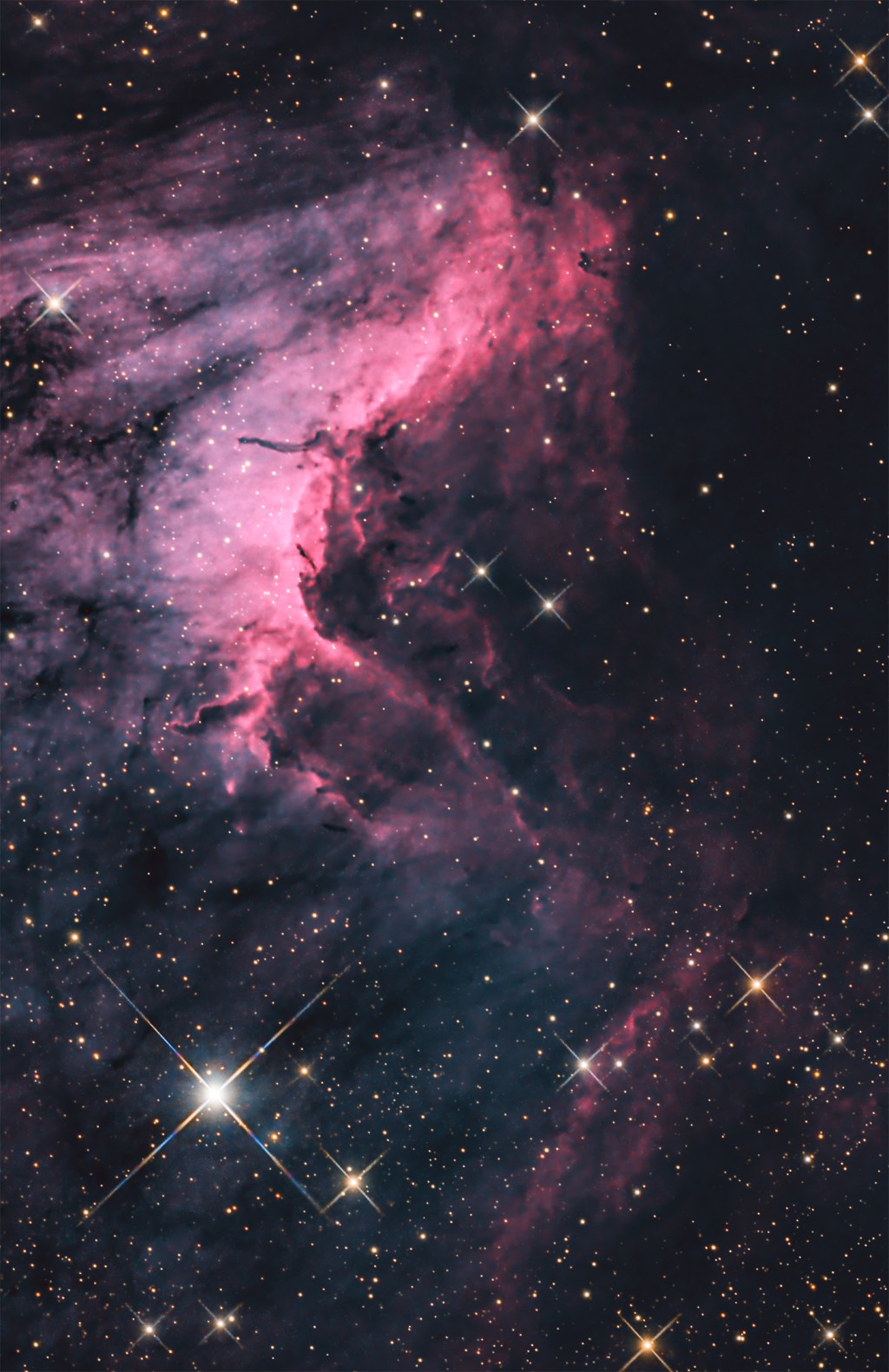
Nestled within the vast tapestry of the Pelican Nebula lies IC 5067—a region sculpted by stellar winds and radiation into towering columns of gas and dust. These cosmic pillars, reminiscent of their more famous cousins in the Eagle Nebula, are active nurseries where stars are born in the quiet chaos of interstellar matter.
Image Acquisition
The final image is a composite of nearly 180 individual frames, each collected through a dual-band Ha/OIII filter. H-alpha, a deep-red whisper from the cosmos, traces regions of ionized hydrogen, while Oxygen III reveals itself in the green-cyan glow of doubly ionized oxygen. These narrow wavelengths unveil the hidden architecture of the nebula, each contributing its own spectral voice to the composition.
During post-processing, I chose a magenta-inspired palette—an artistic interpretation that reflects both the ethereal nature of the Pelican Nebula and my personal vision of its celestial drama.
Star Layer Isolation and Diffraction Spike Technique
To enhance the clarity and separation of the star field from the nebular structures, the stars were processed independently. This involved stacking approximately 60 short-exposure frames taken with a UV-IR cut filter, which helped retain accurate star color and reduce oversaturation.
If you’re wondering about the prominent star featured in the bottom part of the image, it’s 56 Cygni—a double star system with an absolute magnitude of 1.96, located in the constellation Cygnus. Its brightness and position make it a striking visual anchor within the frame.
Notably, the diffraction spikes—often associated with reflector telescopes—were achieved using a refractor. These were not added in post-processing; instead, a custom diffraction mask made from cardboard and fishing line was manually mounted on the front of the optical tube assembly (OTA), producing the star spikes optically during capture. This one I named it The Star Spiker.
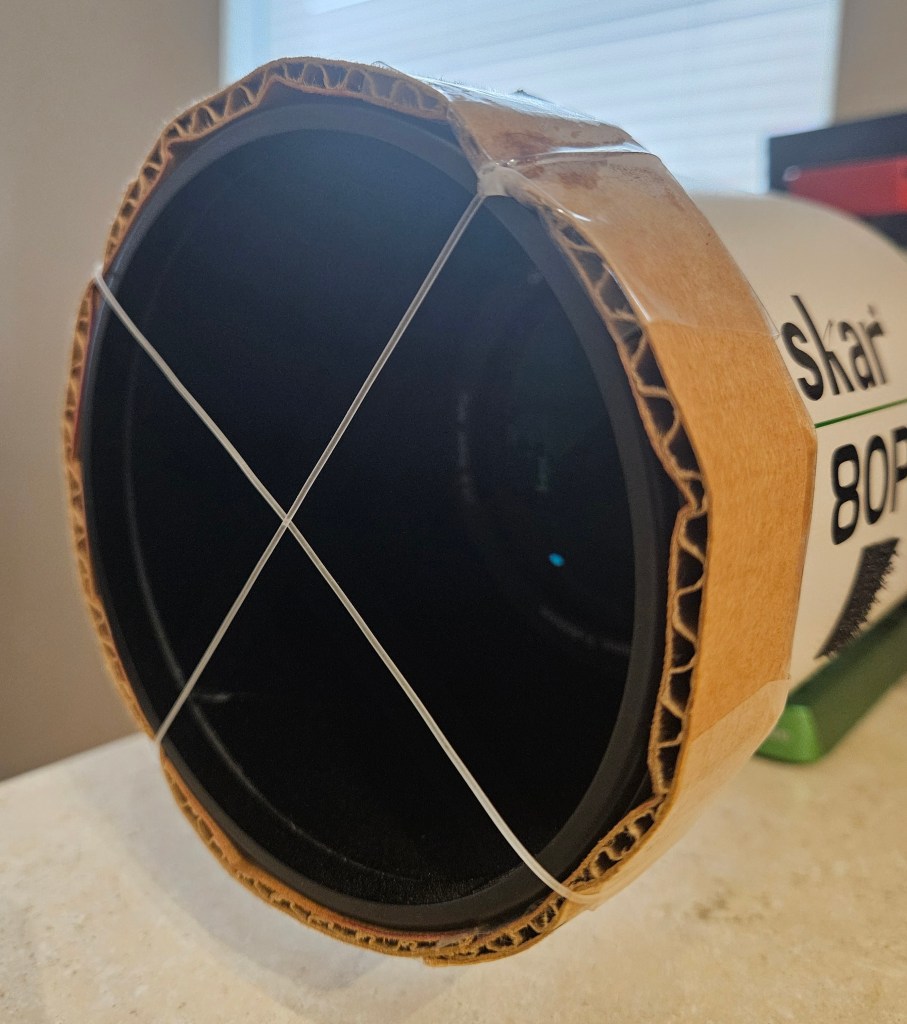
For readers interested in replicating this technique, here’s a helpful guide on How to Make Legit Diffraction Spikes on Stars with a Refractor.
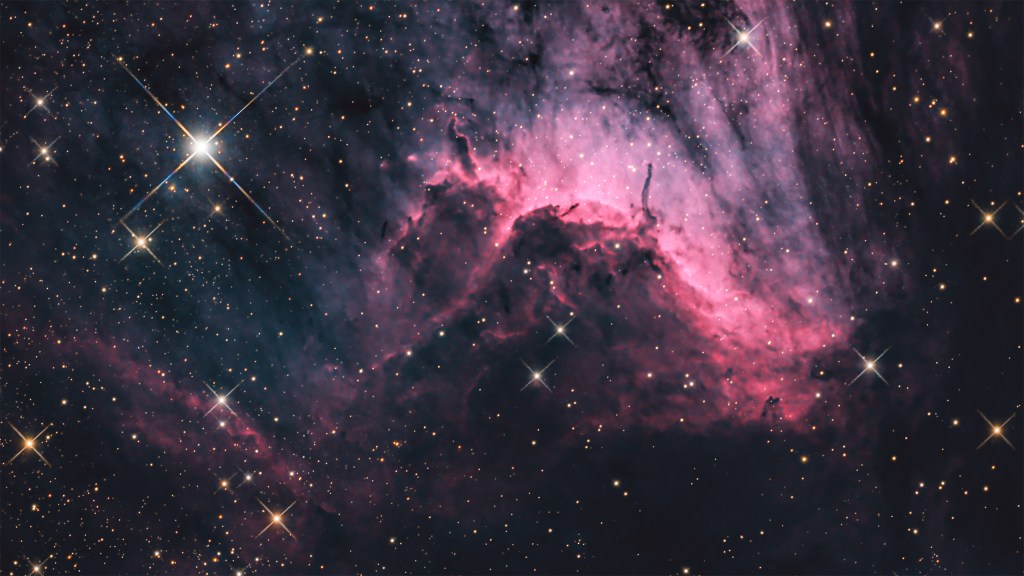
Target Data
- Name: Pelican Nebula
- Catalog Entries: IC 5067, IC 5070
- Constellation: Cygnus
- Hemisphere: North of celestial equator
- Distance to Earth: About 2,000 light years away
- Object Type: Emission Nebula
- Approx Ideal FOV: 1º+
Processing this image was a delicate balance between technical precision and creative expression. Calibration frames were used to reduce noise and enhance signal clarity, and careful stretching brought out the subtle textures within the nebula’s folds. I paid particular attention to preserving the contrast between the dense pillars and the surrounding emission regions, allowing the structure of IC 5067 to emerge with depth and dimension.
The Pelican Nebula, often overshadowed by its neighboring Cygnus landmarks, offers a quiet majesty that rewards patience and curiosity. Through this post, I hope to share not just the technical journey behind the image, but the sense of awe that comes from witnessing star formation in progress, light-years away.
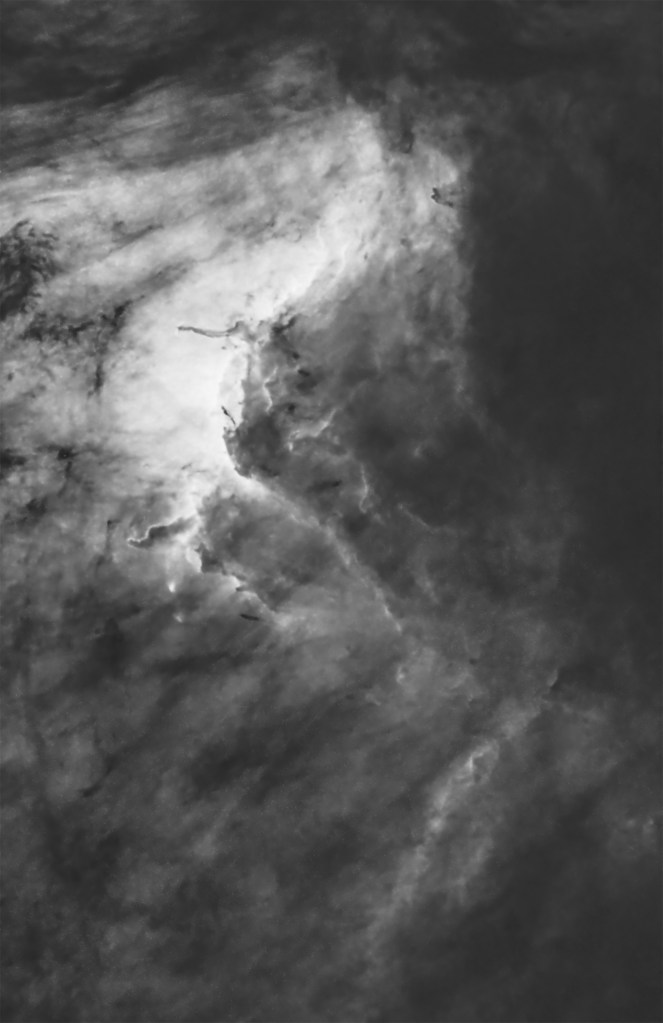
Every pixel in this image was shaped by a deliberate choice—of gear, settings, and software. Below is a breakdown of the tools and techniques that brought IC 5067 to life, from the first photon captured to the final stretch of post-processing.
📷 Imaging Gear
- Camera: ZWO ASI585MC Pro (OSC)
- Filters: Antlia 5nm Duo Narrowband (Hα/OIII)
- Telescope: Askar 80PHQ
- Mount: iOptron HEM15
- Guiding: Askar OAG (Off-axis guider)
- Guide Camera: ZWO ASI120MM Mini
🗓️ Acquisition Stats
- Total Integration Time: 15 hours
- Subframes:
- Hα/OIII: 180 × 300s
- Gain: 252
- Sensor Temperature: 5°C
- Bortle Scale: Class 6 (Bright Suburban Sky)
- Data Source: Backyard
- Capture Software: NINA (Nighttime Imaging ‘N’ Astronomy)
- Guiding Software: PHD2
🛠️ Processing Software
- Calibration & Stacking: Siril, Sirilic
- Noise Reduction: Graxpert, Cosmic Clarity
- Star Removal: StarNet++
- Post Processing: Photoshop 2025
 alexisantonio.com
Leave a comment